
Glenview Window Well Covers & Basement Windows
Glenview is really two housing markets sitting next to each other, and window wells tell you which one you're standing in. The village-wide median year built is 1977 and roughly 40% of homes predate 1970 — those are the corrugated steel wells, often rusted, usually uncovered. Then there is The Glen, the 1,121-acre redevelopment of the former Naval Air Station approved in February 1998, which added 1,969 housing units of late-1990s and 2000s construction with newer wells and different problems.
Both need covers, for different reasons. The older half needs a cover because the well is deteriorating and the window behind it is original. The Glen's newer homes need a cover because a deep, clean well with no cover is still an open bucket next to a finished basement.
We measure every Glenview well on site. Nothing is ordered off a shelf size, and every cover over an egress well opens from inside without a key or tool.
A Glenview Code Rule Most Towns Don't Have
Glenview has adopted the 2021 International Residential Code under Municipal Code Sec. 18-191, and it carries a local amendment that catches people finishing large basements: a basement exceeding 2,000 square feet requires an additional emergency escape opening in the common area, beyond whatever the sleeping rooms require.
That matters for window wells because a second escape opening means a second compliant well — 9 square feet minimum, 36 inches of projection and width, a ladder if it is deeper than 44 inches — and a second cover that releases from inside without a key, a tool or special knowledge.
The base IRC egress numbers still apply: 5.7 square feet of net clear opening, 24 inches minimum clear height, 20 inches minimum clear width, sill no higher than 44 inches above the finished floor. Confirm the current requirements and whether your specific job needs a permit with the Glenview Development Center at (847) 904-4330 — we build to code, but the village is the authority on what your project needs.
Glenview's Flood History And What The Village Did About It
The September 13, 2008 storm produced a 100-year flood event in Glenview and is the reference point for most of the village's drainage work since. Two projects came out of it.
The East Village Flood Control project cost roughly $11 million, including a $6 million grant from the Metropolitan Water Reclamation District, and was completed in summer 2015 serving about 1,150 homes. The West Fork project with the U.S. Army Corps of Engineers was approved July 18, 2017 at $7.7 million, protecting up to 175 homes in the Tall Trees area.
Those projects address channel and system capacity. They do not address the water that lands in an open window well during the storm itself — that water is already inside your well and against your foundation before any storm sewer sees it. A cover is the only thing that keeps it out.
The Overhead Sewer Cost-Share
Glenview runs an Overhead Sanitary Sewer Conversion cost-share in which the Village and the homeowner each pay 50%, up to a total project cost of $15,000. It is a program worth asking about if you are getting sewer backup rather than surface water.
The distinction matters. Sewer backup comes up through floor drains and fixtures during heavy rain. Surface water comes in around basement windows, through the well, and along the foundation. If your water shows up at the window first, that is a window well problem and a cover is the fix.
We handle the well. For the sewer side, the Development Center at (847) 904-4330 can point you to the current program terms.
All our covers:
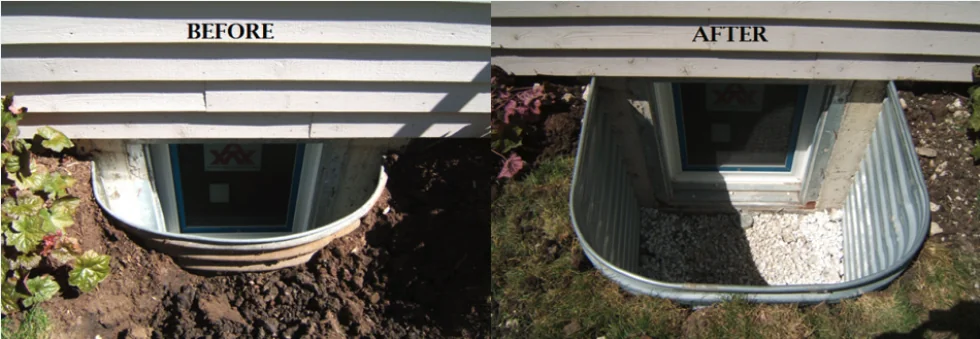
Glenview Window Well Covers | Glenview Window Wells | Glenview Egress Window Wells | Glenview Well Covers | Glenview Basement Window Well Covers