
Orland Park Window Well Covers & Basement Windows
Orland Park's median home was built in 1989 and about 51% of the village's housing predates 1990, which puts a lot of local window wells in the 30-to-40-year range — old enough to have rusted at the soil line, deep enough to matter, and almost always uncovered when we first see them.
Orland Park also has a specific code rule that shapes what we install here: the Village requires guard protection for open window wells deeper than 30 inches. A properly built, load-rated cover addresses the reason that rule exists — nobody steps into a covered well — while still opening from inside for egress.
Every cover we build for an Orland Park home is measured on site to that well's actual opening. Older wells here are rarely square, and a cover that does not sit flush is a cover that lets water in.
The 30-Inch Rule And Other Orland Park Code Details
Orland Park has adopted the 2018 International Residential Code under Village Code 5-1-14, with local amendments that are more specific than most neighboring towns. The one that affects window wells directly: open window wells deeper than 30 inches require guard protection.
Two others are worth knowing if you are finishing a basement here. Egress windows are required in habitable-attic sleeping rooms, not just basements. And basements need natural light and ventilation equal to at least 2% of the floor area — which often means the basement window you have is not big enough for the room you are planning.
Orland Park also explicitly requires a permit for window replacement. That is not universal in the south suburbs, and it surprises people. Check with the Building Division in Development Services at 708-403-6100 before you order anything. Under the 2018 IRC an egress opening needs 5.7 square feet of net clear opening, 24 inches minimum height, 20 inches minimum width and a sill no more than 44 inches above the floor, with the well at 9 square feet minimum and a ladder past 44 inches of depth.
Where Orland Park's Water Goes
Tinley Creek and Mill Creek both drain north out of Orland Park toward the Cal-Sag Channel, and the village leans heavily on detention ponds to hold stormwater on the way. There are 186 village stormwater ponds, all of which were evaluated in 2021.
That evaluation found sediment to be the number one issue across the system, and identified 13 priority pond restorations estimated at $5.6 million. A pond full of sediment holds less water, which means more of a heavy rain stays on the surface, moving across yards and into whatever it finds — including open window wells.
Village Code 4-7-3-3, adopted October 4, 2021, requires that downspouts, roof drains, sump pumps, footing tiles and foundation drains each discharge at grade toward the front or rear of the property, not less than 10 feet from all property lines. It is a rule about keeping your water on your own lot, and it is a good reminder that surface water management starts at the house.
Older Orland Park Homes And Original Wells
The Old Orland Historic District holds the village's oldest housing, and the subdivisions that filled in through the 1970s and 1980s make up the bulk of the pre-1990 half. Those homes almost universally got corrugated steel wells at construction and nothing on top of them.
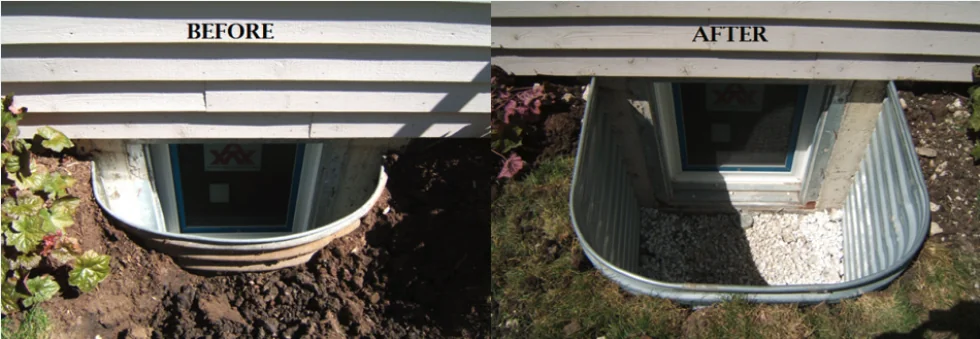
Forty years of freeze-thaw does predictable things: the steel pulls away from the foundation at the top, soil washes into the bottom, and the gravel base that was supposed to drain is now packed dirt. At that point the well holds water instead of shedding it, and the window frame is the first thing to go.
A cover does not fix a well that has already failed, but it stops the process cold on a well that is still sound — and on most Orland Park homes, it still is.
All our covers:
Orland Park Window Well Covers | Orland Park Window Wells | Orland Park Egress Window Wells | Orland Park Well Covers | Orland Park Basement Window Well Covers